
How Uber connects its AI agents to models and tools
In this blog we will see how Uber puts two gateways around its AI agents, and how every call carries the person who asked.
In early 2025, Uber built a platform for its engineers to build agents.[1] Thousands of agents now work across thousands of its services.
Its engineers faced two problems:
- Every agent reached models and services in its own way.
- A service couldn't tell which person an agent was acting for.
In this blog we will see how Uber puts two gateways around its AI agents, and how every call carries the person who asked.
1. API Gateways
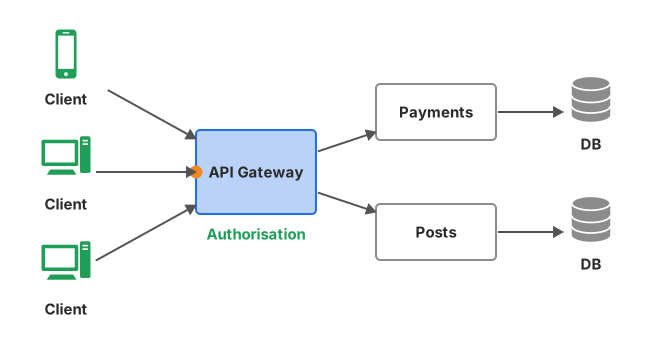
Some kind of authorization or authentication is common across services. So is rate limiting and request validation.
The logic that can be extracted out and put into a single entry service is put in an API gateway.
A server that stands between the clients and the services, and does their common work, is called an API gateway.
2. What does an agent call?
What would a gateway for agents stand in front of? Follow one agent at Uber.
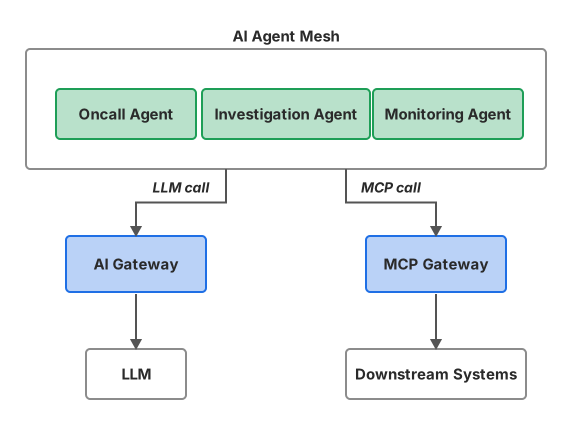
If an on-call engineer starts a session with the Oncall Agent, the Oncall Agent hands part of the work to an Investigation Agent.[1]
Each agent calls two kinds of things. It calls a model to think, and it calls tools to look at Uber's systems.
Many of the models sit outside Uber. OpenAI and Anthropic host some of them. The tools sit inside, in front of thousands of services.
So Uber puts a gateway on each side.
3. The first gateway: models
What leaves Uber when an agent calls a model? Its prompt, and the prompt may hold a customer's data.
Every call from an agent to a model goes through Uber's AI Gateway.[1] Before the call leaves Uber, the gateway's guardrails, called AI Guard, do three things:
- They check for prompt injection and jailbreaks.
- They check for unsafe content.
- They redact personal data.
No agent at Uber calls a model vendor directly. A gateway that stands between agents and models is called an AI gateway.
4. The second gateway: tools
Who writes the tools an agent calls?
The Investigation Agent now needs data from one of Uber's services. Somebody has to turn that service's API into a tool.
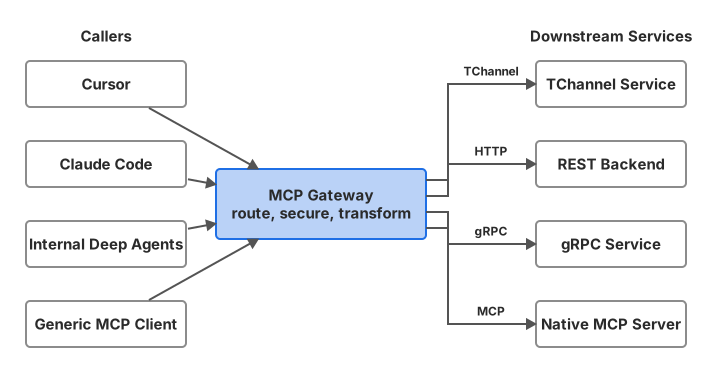
Uber's services speak HTTP, gRPC or TChannel. Agents speak the Model Context Protocol, or MCP. Asking every team to write an MCP server by hand "would be slow and painful".[2]
So the MCP Gateway does three jobs:
- It takes MCP calls from every caller.
- It routes each call to the right service.
- It translates the call into that service's protocol, and the answer back.
Where do the gateway's tools come from? A crawler called AutoCrawler builds them:[2]
- It reads every service's API definition, on a fixed schedule.
- An LLM writes each tool's description.
- The tool is registered, switched off.
- The team that owns the service reviews it and turns it on.
Why on a schedule? Because a service's API changes, and the gateway has to keep up.
The API is literally a contract. So if you send a request, you get a response.
But what if a new type of request has to be added? What if a new API has to be added? What if the API has changed?
So in these cases, there is a change in contract. And therefore, the API gateway needs to be informed of that. And it needs to reflect those changes.
So how do you do that? Restart the API gateway.
And gateway engineers got crazy. They used to spend like 20 to 25% of their sprint times just maintaining the service or just restarting things.
Uber's gateway restarts for none of it. The crawler picks up a changed contract on its next run, and the gateway refreshes its tools in memory.
The part of a system that decides what may run is called the control plane. At Uber, that is the MCP Registry, where teams turn tools on.
The part that carries the calls is the data plane. It sends each call out through Muttley, the sidecar beside every Uber service.
5. Who is the agent acting for?
Would you answer a call without knowing who is asking?
The service now gets a call from the MCP Gateway. It has to decide whether to answer.
Okay, the benefit, like we said, is number one, when requests come in here, you can go for authorization.
Is this user, is Gaurav allowed to make this request to the payment service?
With agents, that question has more than one name in it. The engineer asked the Oncall Agent, which asked the Investigation Agent, which asked for the data.
Without that chain, the service sees only that "some service called an API".[1] The Oncall Agent can't reuse the engineer's own credentials either. The web solved this problem for people a long time ago.
This process of outsourcing user authentication (technically authorization, since the user authorized you to view their name) is called OAuth.
Uber gives its agents the same kind of signed pass. An agent gets one in four steps:[1]
- It fetches an SVID from SPIRE. The SVID proves which machine the agent runs on, but not which agent it is.
- It asks the Security Token Service for a token.
- The token service checks that the agent is registered in the Agent Registry.
- The token service returns the token.
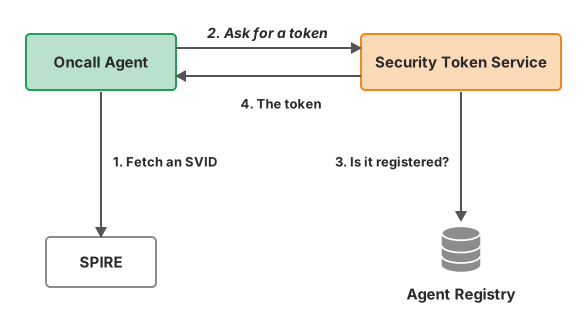
Each token is good for one hop, to one audience, for a few minutes. It carries the names of everyone who asked, in order. That list is called the actor chain.
Uber's post calls the engineer user1. Here is a sketch of the token the Investigation Agent sends to the MCP Gateway. A shared key stands in for the token service's signature.
import hashlib
import hmac
import json
import time

KEY = b"held-by-the-token-service-only"


def mint(chain, audience, minutes=5):
    claims = json.dumps({"chain": chain, "aud": audience, "exp": time.time() + 60 * minutes})
    return claims, hmac.new(KEY, claims.encode(), hashlib.sha256).hexdigest()


def accepts(token, me):
    claims, signature = token
    signed = hmac.compare_digest(signature, hmac.new(KEY, claims.encode(), hashlib.sha256).hexdigest())
    body = json.loads(claims)
    return signed and body["aud"] == me and body["exp"] > time.time()


token = mint(["user1", "oncall-agent", "investigation-agent"], audience="mcp-gateway")
print(json.loads(token[0])["chain"])
print("the MCP Gateway accepts it:", accepts(token, "mcp-gateway"))
print("another service accepts it:", accepts(token, "another-service"))
['user1', 'oncall-agent', 'investigation-agent']
the MCP Gateway accepts it: True
another service accepts it: FalseThe token works only where it was sent. A stolen token opens one door, and only for a few minutes.
Final Request Flow
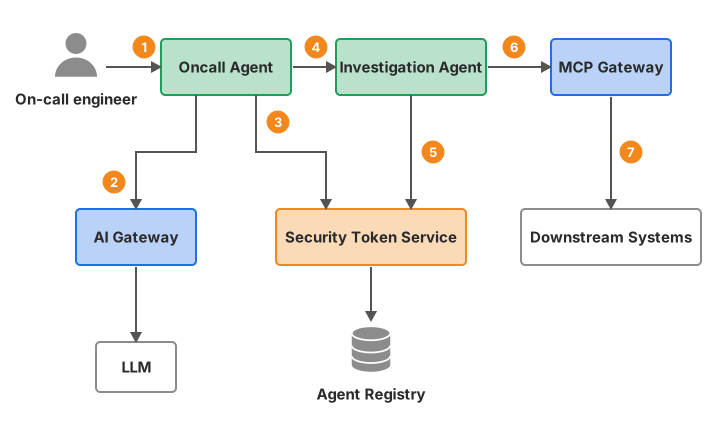
How does the engineer's request reach the service? Here is the whole trip, in seven steps.
- The engineer starts a session with the Oncall Agent.
- The Oncall Agent calls a model through the AI Gateway.
- It gets a token from the Security Token Service, which checks the Agent Registry.
- It hands the work to the Investigation Agent, with the chain user1, Oncall Agent.
- The Investigation Agent gets a token for the MCP Gateway, with the chain user1, Oncall Agent, Investigation Agent.[1]
- The MCP Gateway checks the token and the tool's policy, and redacts sensitive data.
- The MCP Gateway calls the service in its own protocol, through Muttley.[2]
A token exchange takes under 40 milliseconds at the 99th percentile.[1] The MCP Gateway now hosts over 800 MCP servers and over 5,000 tools.[2]
Those 5,000 tools are plumbing, and so is every step above. Uber's engineers put the lesson in one line: "the hardest part isn't the AI. It's building the connective tissue".[2]
Summary
- An API gateway does the common work of many services, like checking who is calling.
- An Uber agent calls models outside Uber and tools inside it.
- The AI Gateway carries every model call, with guardrails and personal data redacted.
- The MCP Gateway turns every service's API into a tool, on a schedule, with no restarts.
- A new tool starts switched off, and the owning team turns it on.
- A token service mints one token for each hop: one audience, a few minutes, and the actor chain.
- The MCP Gateway hosts over 800 MCP servers and over 5,000 tools.
Sources
- Solving the Identity Crisis for AI Agents, Uber Engineering, 21 May 2026.
- Designing MCP Gateway: Uber's MCP Management Platform, Uber Engineering, 1 October 2026.
