
AI Engineering Roadmap 2026
In this blog we will see what a software engineer should learn for AI engineering, in what order, and how to know it is enough.
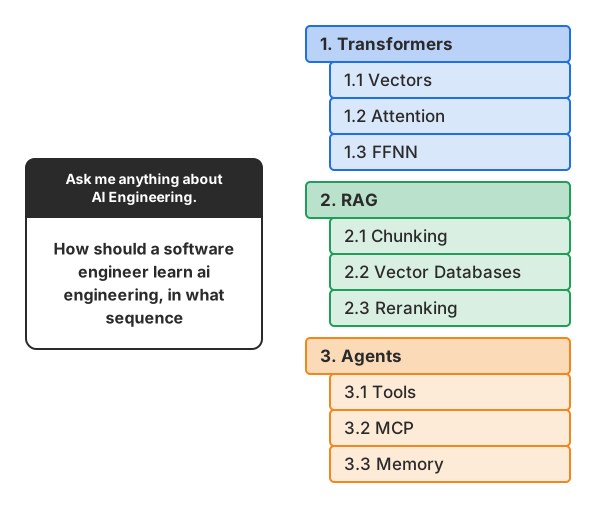
In June 2026, a software engineer asked me a question under "Ask me anything about AI Engineering".[1] The question was how a software engineer should learn AI engineering, and in what sequence.
In September, Tanishq Singh and I answered it again in a live session, at more length.[2] Software engineers who wanted to move to AI faced three problems:
- There was too much to learn, and no order to learn it in.
- They didn't know when they knew enough.
- Nobody saw what they had built.
In this blog we will see what a software engineer should learn for AI engineering, in what order, and how to know it is enough.
1. Transformers
What should a software engineer learn first? The model that every AI application calls, the transformer.
Number one, you want to know how transformers work. In that, vectors, attention, feed-forward networks work.
At a high level, you don't have to actually work with this ever in your life. But knowing binary search is useful to understand databases, which in turn is useful for you to be a database engineer.
So knowing how the transformer works helps you understand how AI systems work, which helps you become a better AI engineer.
How deep is that? Not as deep as a researcher. In the live session I put it this way: "start with transformers, but not Attention Is All You Need or some research paper".
As an AI engineer if you don't know what a transformer is then there's a problem, because tomorrow if there's a diffusion based model which comes in, or if there is a world model which comes in, and you don't even know what is the difference between the capability of a transformer and capability of something else, then you might as well not be an AI engineer.
It's the engineer who can't tell SQL from NoSQL. They are no different from a non-technical person when it comes to choosing a database. For why the math can wait, see our blog on whether to learn ML before AI.
2. RAG
How does the model answer from your company's documents? It knows only what it was trained on.
Now, after you have learnt that, the basics, you want to move to the application side. So, how a RAG system is built.
I'm talking about how do you re-rank, how do you chunk, how do you index, what are vector databases. Second part done, application.
So the order inside RAG matters too, as Tanishq said in the live session. Chunking comes first, because "the boring part is the most important part". Re-ranking comes after a basic RAG system works.
3. Agents
RAG answers questions. What does a model need before it can act?
Third part, what is recent, what is actually working? Agents. So, in agents, what is memory, what are tools, what is MCP? These are the things that we want to work on, okay?
Agents are what people use most today. Claude Code and Codex are agents, and so is every coding assistant.
4. Evals
What did the list leave out? Transformers, RAG and agents make its three parts.
Something that we didn't discuss is evals. Evaluation of any AI application is either evaluating an agent or evaluating a RAG pipeline or evaluating sometimes even a basic LLM call, so the system prompt itself. This is something that you should know, that you absolutely must know.
So the roadmap has four parts: transformers, RAG, agents, and evals across all three. For each part, read research papers and blogs from big tech companies such as Google, OpenAI and Anthropic. The engineers who run these systems explain them best.
5. What should you build?
You read about RAG and you build a toy project. Is that enough?
It's enough when you build something with a goal, for someone who needs it. Most of us ask what we could build, when there needs to be an objective first.
Creating a company project with real world impact is most important. Then publishing about it in the company blog or a reputed journal gets you the right attention and eyeballs for career growth.
If that doesn't work, create something for yourself, since it has localized impact. If you see opportunity for community and an active audience, do that, number three, like the pothole reporter.
Self motivation is hard, so choose in order of impact.
So build in this order:
- A project for your company, with real-world impact. Tanishq's suggestion is a chatbot over your team's common documents.
- A project for yourself, such as an expense tracker or a health tracker with only your own metrics.
- A project for a community with an active audience, like the pothole reporter.
Then evaluate it. If the app answers like an idiot, it isn't built properly yet, and the evals show you where. Without evals, you are only practising.
6. Show what you built
Who knows you built it? Only the people you tell.
Whatever work you do, whatever thing you learn, post about it, build a community, share, or be a part of the community. If you don't have to build a community, you can at least be part of it.
Let everyone know what you are doing so that you get the right kind of attention from the right people.
Where should you post it? In this order:
- A company blog or a reputed journal. A company blog stays up for years, and recruiters and senior managers read it.
- A public event or a public blog. If you get a chance to speak at a conference, take it.
- Social media. You don't need a million followers: a thousand views can still bring the right people to you.
A post with numbers in it reads best, with your manager's permission. For example, the RAG pipeline was 80% accurate before, and now 95% of the customers are happy.
7. Why move to AI now?
Why not wait until your company asks for AI?
Because it already has. In the live session I said that AI roles grew while openings for software engineers shrank, freshers' roles too.
People who used to build libraries earlier, they were called platform engineers, which the entire developer team could access, right, so they were the hottest commodities in the company. So like that, AI right now is becoming like a platform, that multiple teams want to use AI and very few people are actually getting to build those AI integrations.
We are seeing that the very small teams actually get the opportunity to take care of the AI platform. So now's a good time to move.
Summary
- Learn how transformers work at a high level: vectors, attention and feed-forward networks.
- Then learn RAG: chunking first, then vector databases, then re-ranking.
- Then learn agents: tools, MCP and memory.
- Learn to evaluate all three. Without evals, you are only practising.
- Read research papers and blogs from big tech companies.
- Build in order of impact: for your company first, then for yourself, then for a community. Evaluate it.
- Publish it: a company blog or a reputed journal first, then public talks and blogs, then social media.
Sources
- AI Engineering Roadmap 2026, Gaurav Sen, 1 June 2026.
- AI Engineering Roadmap: 2026, Gaurav Sen and Tanishq Singh, live session, 9 September 2026.
